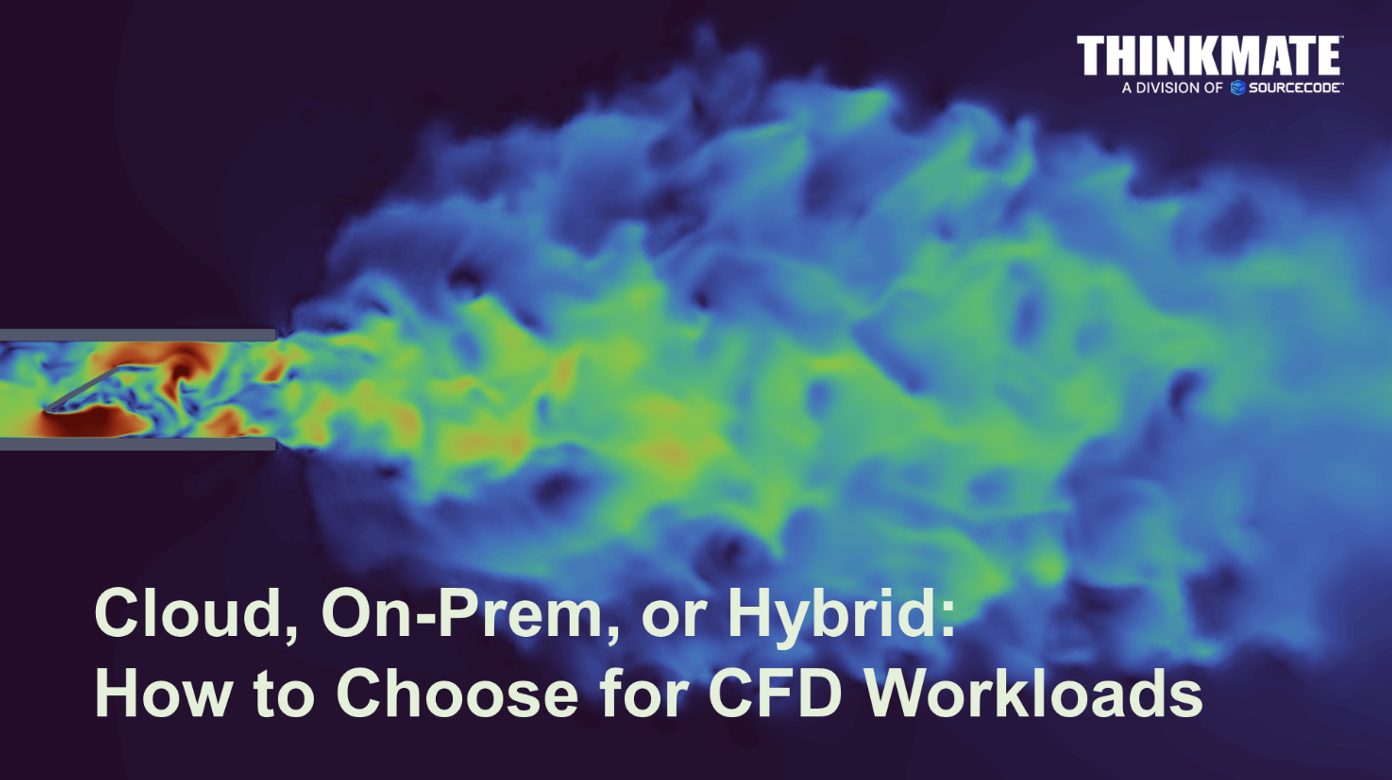
If you're running Computational Fluid Dynamics (CFD) simulations at scale, you've probably had this conversation with your team: do we stay on-prem, move to the cloud, or do something in between?
The answer is: it depends. Cloud providers have invested heavily in HPC offerings, and for certain workloads, cloud makes a lot of sense. But CFD is not a generic workload, and the infrastructure decisions you make early can have a significant impact on performance, data security, and cost over time.
Here's how to think through the trade-offs.
What Makes CFD Different
CFD simulations are computationally intensive, tightly coupled, and highly sensitive to network latency. Large parallel jobs, especially those running solvers like STAR-CCM+ or Ansys Fluent, require fast, low-latency communication between nodes. When that communication is bottlenecked, the simulation slows.
CFD jobs also tend to involve large datasets that can run into the terabytes for complex models. Moving that data in and out of cloud storage adds both latency and cost.
These characteristics set CFD apart from many other HPC workloads and they matter when you're evaluating infrastructure options.
The Case for Public Cloud
Cloud is often the easiest place to start. It can be a good fit, but it depends on how you're using it. Cloud infrastructure works well when:
For proof-of-concept work or occasional large runs, cloud can be a cost-effective starting point. The problem is that many engineering teams outgrow this use case, and that's when the economics start to shift.
When Cloud Falls Short for CFD
As simulation workloads grow in frequency and complexity, several cloud limitations become more apparent:
Network latency and performance variability
Public cloud networks are typically shared infrastructure. For tightly coupled parallel jobs, the latency between nodes can introduce performance penalties. On-premises clusters with high-speed, low-latency interconnects like InfiniBand are purpose-built to minimize this.
Cost at scale
Cloud compute pricing is designed for variable, transient workloads. Teams running frequent, large-scale CFD jobs often find that cloud costs scale faster than expected, especially when egress fees, storage, and licensing are factored in. What looks affordable at low utilization can get expensive fast.
Data control and security
For aerospace, defense, and automotive applications, simulation data is often sensitive IP. Keeping that data on-premises eliminates a significant category of risk and may be a compliance requirement in certain industries.
Software licensing complexity
Many CFD solvers use licensing models tied to core counts or tokens. Cloud environments can make this licensing unpredictable or expensive, particularly if you're bursting to large node counts. You can end up paying twice: once for compute and once for license overages.
When On-Prem Makes Sense
A well-designed on-premises CFD cluster addresses most of the cloud limitations above, but it comes with its own set of considerations. There is an upfront investment for on-premises infrastructure, but for teams with ongoing simulation needs, it typically delivers better total cost of ownership over a 3–5-year horizon, as well as significantly better performance.
On-prem works well when:
Modern on-premises CFD clusters can also be designed to be highly manageable. Solutions like Warewulf, a leading open-source cluster management platform, simplify deployment, configuration, and ongoing administration making on-prem more operationally accessible than it used to be.
A well-architected on-premises cluster can also let you upgrade the system as you go to match new algorithms and evolving workloads.
What About Hybrid?
A hybrid approach combines on-premises infrastructure for core workloads with cloud burst capacity available when needed. It can be the best of both worlds, provided it's designed with intent.
Hybrid works well when:
The challenge with hybrid is that it requires thoughtful architecture to avoid getting the downsides of both approaches. If data has to move between environments for every job, latency and cost add up. Hybrid works best when bursting is infrequent, or when local and cloud resources are used for genuinely different job types, not as a fallback when on-prem is full.
How to Evaluate Your Workload
Before deciding on an infrastructure model, it helps to understand your workload profile. A few questions to consider:
The answers to these questions will help you determine where the right balance lies.
Thinkmate's Approach
Thinkmate engineers every CFD cluster configuration around your specific workload requirements and anticipated future needs. That means starting with your simulation environment, your solver requirements, your performance goals, and cost envelope over time, and then engineering a balanced, cost-effective system around them.
Thinkmate’s CFD Cluster configurations are purpose-built for simulation workloads, scalable from small deployments to clusters with hundreds of nodes, and leverage open-source tools to keep management straightforward and based on established standards to avoid vendor lock-in. All systems are built to order and tested in the U.S., backed by over 30 years of HPC experience.
We work with teams across aerospace, automotive, oil & gas, pharmaceutical research, and general engineering and scientific discovery research, and we can help you think through the right infrastructure model for where you are today and where you're headed.
If you'd like to talk through your CFD environment, reach out to the Thinkmate team at tmsales@thinkmate.com.
Note: Make sure you read and share our recent blog on the impact of rising memory prices and supply shortages and how Thinkmate can help you navigate.